
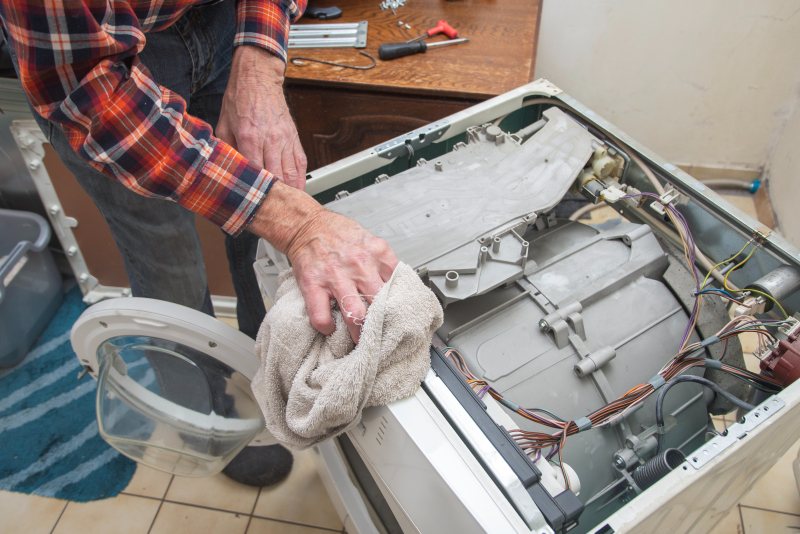
Everyday life in the modern home relies on predictability and automation. We depend on household appliances to save us time and effort, turning complex domestic tasks into the press of a few buttons. That is why the moment you open the washing machine door expecting semi-dry laundry, only to find soaking wet, heavy clothes sitting in residual water, can be extremely frustrating.
When the washing machine won't spin, the problem may range from an easily fixable user error to a serious technical fault requiring the intervention of a certified specialist. In this guide, we will take an in-depth look at the mechanical and electronic factors that can cause this symptom, how to inspect the appliance safely and when it is critically important to seek professional help instead of taking risky action yourself.
Why the Washing Machine Won't Spin: Possible Causes
To understand why a washing machine is not spinning, we need to look at the process as a complex sequence of commands and mechanical actions. Spinning is the final stage of the programme, during which the drum must reach high speeds, usually between 400 and 1,400 revolutions per minute, in order to extract moisture from the fabrics using centrifugal force. If just one element in this chain fails, the machine's software blocks the process for safety reasons.
Among the main technical reasons why a washing machine won't spin are faults in the drive system, worn components or software errors, such as:
- Worn carbon brushes on the motor: In washing machines with brushed, or universal, motors, the carbon brushes provide electrical contact with the rotor. This type of motor is still widely used today, especially in mid-range models. When the brushes wear down and their length falls below the critical minimum, the motor loses power. It may still be strong enough to rotate the drum slowly during the wash cycle, but unable to develop the necessary torque for the high speeds required during spinning.
- Stretched or broken drive belt: The belt transfers movement from the motor to the drum pulley. Over time, the poly-V belt wears out, starts slipping when the machine tries to accelerate and prevents the appliance from reaching the high speed needed for spinning. If the belt snaps completely, the drum will not turn at all, even though the motor may still be heard running. It is important to note that this component is not present in washing machines with direct drive systems, such as LG Direct Drive and similar technologies, where the motor is connected directly to the drum.
- Fault in the speed sensor: In brushed motors, this function is performed by a tachogenerator. In inverter motors, feedback is provided by Hall sensors or by measuring the back electromotive force in the windings. If the speed sensor is faulty, the electronic control board does not receive information about the actual rotation speed and blocks the spin cycle as a protective measure against uncontrolled acceleration.
- Fault in the electronic control module: The control board is the brain of the washing machine. Burnt relays, triacs or broken tracks in the motor control circuit can prevent the signal for the final cycle from being sent.
What Should You Check First When There Are Problems with Spinning?
Before you panic and assume the worst-case scenario, it is important to rule out several factors related to the way the appliance is being used, as these do not require technical repair.
Uneven Distribution of Laundry - Imbalance
Modern washing machines have a built-in imbalance control system. When you put in just one large and heavy item, such as a thick blanket, jacket or bulky bathrobe, together with a few small garments, the appliance tries to distribute the weight evenly around the walls of the drum before spinning. If this proves impossible, the sensors detect a high risk of dangerous vibrations that could damage the appliance. As a result, the machine makes several attempts to start spinning, then stops the programme and leaves the laundry wet.
Overloading or Underloading the Appliance
Every model has a specific capacity in kilograms. Overloading makes it physically difficult for the motor to turn the drum. On the other hand, too small a load, for example two T-shirts, can also cause imbalance because there is not enough mass to distribute evenly around the drum.
Incorrectly Selected Programme
Check the control panel. Some specialised programmes for delicate fabrics, wool or silk switch off the spin cycle by default or limit it to a minimum speed, for example 400 rpm, which leaves clothes significantly wetter. Also make sure that the Rinse Hold button has not been activated.
Drainage Problems: One of the Most Common Symptoms
Technicians' experience shows that in a very large percentage of cases where the washing machine won't spin, the real source of the problem lies in the drainage system. The appliance's automatic algorithm is programmed so that spinning will not start until the water level in the tub has fallen below a certain minimum, as detected by the pressure switch, or water level sensor.
If the pump fails to drain the water within the time set by the software, the programme stops. The most common reason for this is a blocked debris filter. Coins, hairpins, buttons, forgotten documents or accumulations of lint from clothes regularly end up there. When the filter becomes clogged, water flow is restricted and the water remains inside.
Another possible factor is a jammed impeller in the pump itself, or a bent, pinched or blocked drain hose or waste connection. Checking and cleaning the filter is a straightforward procedure that every user can carry out by following the operating instructions for their specific model.
If, after cleaning the filter, water still remains in the tub or the pump makes unusual noises without pumping, the problem is probably an electrical or mechanical fault in the component itself. RotoRem's mobile teams in Sofia and Varna have original spare parts and offer fast home diagnostics and repairs, with the ability to replace faulty parts during the first visit.
Noise During Spinning: When Is It Normal and When Is It a Sign of a Fault?
Spinning is the noisiest phase of the appliance's operation, but every long-term owner becomes familiar with the natural sound of their own machine. The appearance of a new, unusual and loud noise during the spin cycle is a clear indication that the internal components are under strain.
Recognising the character of the sound can help point you towards the nature of the problem:
- Rhythmic grinding, metallic or whining sound: This is a classic symptom of worn drum bearings. The bearings ensure smooth rotation. When the shaft seal becomes worn, water enters the bearings and washes away the lubricant, which leads to rust and rapid deterioration.
- A loud noise resembling an aeroplane taking off: Requires immediate discontinuation of use, as complete bearing failure can damage the drum spider and the outer tub itself, making the appliance beyond economical repair.
- Heavy banging and the machine jumping: If the appliance is banging heavily against the walls of its casing, the cause is most often the shock absorbers or suspension springs. The shock absorbers absorb and dampen the vibrations of the tub. Over time, they lose their effectiveness and the tub starts moving freely. This is detected by the control electronics, usually by analysing fluctuations in the motor current or unstable readings from the speed sensor, and in higher-end washing machines also through separate 3D vibration sensors. When a high imbalance is detected, the machine stops the spin cycle as a protective measure.
- Loud irregular rattling: This is often caused by a foreign object, such as coins, buttons, bra underwires or similar items, that has passed through the door seal and is now trapped between the drum and the plastic outer tub. At high speeds, it strikes the metal walls and may puncture the tub.
"Burnt-Out Spin Cycle" in a Washing Machine: What Does This Problem Actually Mean?
In everyday language, users often use the phrase "the washing machine's spin cycle has burnt out". From a technical point of view, modern automatic washing machines do not have a separate motor or separate unit called a "spin cycle". The entire process is carried out by one main motor, either brushed or inverter, controlled by the electronics.
When people refer to a burnt-out spin cycle in a washing machine, this usually means one of the following two serious faults:
- Short circuit or break in the motor windings: The stator or rotor windings may overheat and burn out due to overloading, moisture ingress or a manufacturing defect. In this case, the motor either does not start at all or loses the ability to switch to high speeds.
- Burnt-out power section on the control board: The control module contains electronic components that distribute power to the motor. If one of these elements fails as a result of a power surge in the mains, the machine loses control over the speed and the software refuses to run the cycle.
These faults are complex and require diagnostics with specialised measuring equipment, such as multimeters and oscilloscopes, in order to determine whether the component can be repaired or must be replaced with a new one.
How Can You Reduce the Risk of the Washing Machine Stopping Spinning?
It is impossible to completely prevent technical wear, but following a few basic rules can drastically reduce the likelihood of sudden faults:
- Sort and distribute laundry correctly: Avoid washing single large items on their own. Combine them with smaller garments to achieve better balance in the drum.
- Use laundry bags: Small items such as children's socks, underwear and clothes with metal elements should be washed in special mesh bags so that they do not end up under the drum or inside the filter.
- Clean the filter regularly: Check the pump filter at least once every 2-3 months.
- Do not exceed the detergent dose: Excess foam acts like a cushion and prevents the pressure sensors from correctly detecting the water level, which confuses the software when transitioning to the spin cycle.
Conclusion
When you encounter a problem where your washing machine stops spinning normally, the key is a systematic approach and an accurate assessment of the situation. Checking the filter and the balance of the laundry is an excellent first step that you can take yourself. However, if the symptoms point to worn bearings, a faulty pump or electronic failure, the intervention of a qualified technician will ensure a longer service life for the appliance and safety for the household. To save yourself time and further complications, contact the experts at RotoRem for accurate diagnostics and reliable on-site repairs.
Frequently Asked Questions
Why Does the Washing Machine Turn Slowly but Not Switch to a Fast Spin?
This is classic behaviour when the appliance has not detected a balanced load or when the pump is partially blocked and is draining the water slowly. It can also be an early sign of worn motor brushes that no longer have enough power for acceleration.
Is It Dangerous to Use the Washing Machine If I Hear a Loud Noise During Spinning?
Yes, it is extremely risky. If the source is damaged bearings or faulty shock absorbers, every subsequent spin cycle exposes the entire appliance to severe mechanical impact. This can lead to irreversible damage to the outer tub, drum spider and drum, water leakage through the damaged shaft seal and, ultimately, can make the repair economically unjustifiable.
Can an Electrical Problem Prevent the Washing Machine from Spinning?
Yes, modern inverter washing machines are sensitive to significant fluctuations in the electrical supply. If the voltage drops below approximately 190-200V, with the exact value depending on the model and manufacturer, the control board may block the most energy-intensive process - reaching the high speeds required for spinning - in order to protect the motor and power electronics from overheating.
This article has been prepared for informational purposes and does not replace professional technical diagnostics.